
Tailwind Tuesday: Density Altitude Again

Welcome back to Tailwind Tuesday. When was the last time you flew to an airport with a density altitude over 5000’? Some of you may laugh because that’s your home airport elevation on a good day. For others of you, taking off from the ground when your airplane already feels as if it’s joined the mile-high club can be quite nerve-racking. I joke, but as summer approaches, I wanted to share a story from a flight earlier this year when I took a student to the highest airport in North America, Leadville, CO. Density altitude creates hidden traps for pilots, even in high-performance aircraft. The atmosphere becomes thinner the higher you go. When you fly your airplane at higher altitudes, the engine produces less power, the propellers produce less lift (thrust), your wings produce less lift, and the airplane slips through the air faster (takes up more ground to stop and take off). We’ll dive into each one of these in more detail, but first, what happened with my student in his new baron?
Story
It’s a beautiful morning flight out west to the Rocky Mountains. I’m taking a new owner through his transition course into the Beechcraft Baron 58—a capable, comfortable family plane with plenty of power to get you there. To give him time to learn about aircraft systems and see a new place, we flew out to Leadville, Colorado. Leadville is the highest airport in North America, and he hadn’t experienced altitudes that high before. On our way out, we talked about some of what he could expect, as well as the different techniques we would use during landing and takeoff. Because the airport is so high, the air is quite thin, and it only gets worse as the afternoon sun heats up the atmosphere. The beauty of the mountains masks the dangers lurking for inexperienced pilots as they scream towards the ground on final approach. Thin air increases your speed across the ground but doesn’t change your indicated speed. The decrease in air density increases the landing distance, which, when faced with a cliff at the end of the runway, doesn’t exactly make you feel comfortable. That’s why knowing your aircraft and its performance matters.
I’ve flown to Leadville multiple times, and the part that always confuses students is that, before landing, we don’t really adjust the fuel mixture. On this particular trip, I instructed my student to push the mixture controls forward a little while leaving them leaned more than usual. He did exactly that, and once we were safely on the ground, I had time to explain why. The “why” is obvious once you look at the bigger picture. What altitude are we landing at? Almost 10,000 feet! It’s like being at normal cruise altitudes on a cross-country flight, where you have your mixtures set for best power and temperature per the manual. You enrich them slightly in case of a go-around, but if you add too much fuel, you could flood the engine and prevent it from producing optimal power. When you’re at an airport at such a high altitude, every bit of power you can get matters, and many a pilot has suffered from misunderstandings of high-altitude airport operations.
Once we were on the ground, I had the opportunity to look through the aircraft performance charts and have him calculate his takeoff and safety margin. He quickly realized that even if he wasn’t at max weight, he could be in danger, depending on the weather. My student commented on the takeoff and climb performance on our way back home later, “That was different. I see why you need to know that stuff before you go.” You may be able to get into an airport, but can you get out again?
The second story about Density Altitude
Why do I share another story about density altitude? If you remember the first one, I flew with a student in a Cessna C150 out of the Denver area and barely cleared the obstacles. If you haven’t read that story, you can do it here. ADD HOTLINK. My job as an instructor is to improve aviation safety through education, and we lose planes and pilots every year to density altitude. A rough estimate from NTSB aircraft accident data shows that around 50 accidents a year occur due to a pilot failing to account for density altitude.
What can you do about density altitude?
Understand your aircraft. Ask why the performance chart ends at 10,000’ and understand what it means when you go beyond the tested data. Understand the risks associated with high-altitude airports and hot summer days. Run all your numbers and fly as professionally and as well as you can. The biggest thing you can do? Don’t go if the weather doesn’t favor you. Most accidents stem from the “get-there-itis” thoughts. Remember the old saying, if you have time to spare, go by air.
Air density and density altitude
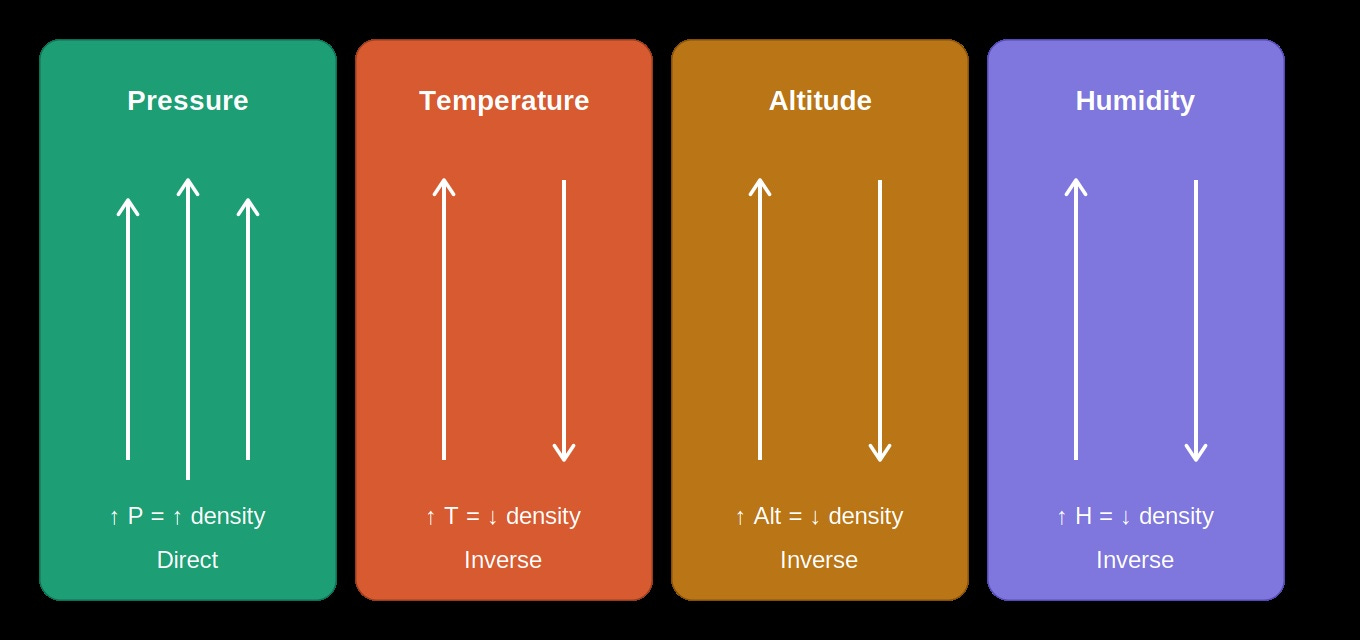
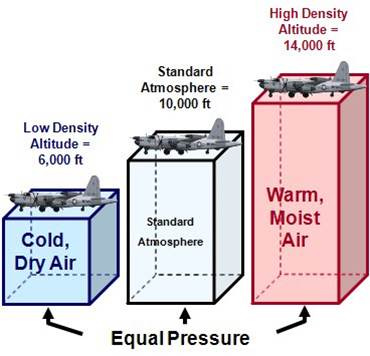
As an aircraft climbs higher in the atmosphere, air density decreases. Pilots refer to this relationship as density altitude (DA). So, when we talk about a “high density altitude,” we mean that the air is thinner than usual. Temperature, humidity, pressure, and altitude all affect air density. Air density decreases as temperature, humidity, and altitude increase, but increases as air pressure increases.
Why does performance decrease with DA?
The air is thinner at higher altitudes. There, that’s your answer. Not happy? Okay, let me explain without getting too technical. The air closer to Earth’s surface has more stuff above it, pushing it down and making it denser. As you go further away from the ground, the air gets thinner for two reasons: there is not as much air compacting the air beneath it, and the air has to fill a larger space with the same amount of air that you find at the ground.
Less air means you can fly faster through it and burn less fuel, which is great for cruise, but not so much for takeoff and landing.
Wings and Props:
With less air to push against, the wings and propellers make less lift. Think of it like trying to swim through the air vs the water. Your hands move more easily through the air, but you aren’t going to go anywhere. When you swim in the water, it’s harder to move your hand, but you can actually go somewhere. That relationship is like what happens on a smaller scale when your propeller and wing try to create lift at higher altitudes.
Engines:
Think about how it’s harder to breathe when you’re climbing a mountain? No, it’s not just because you’re out of shape although that might be part of the problem. The real issue comes from thin air. Each breath you take at higher altitudes contains less oxygen than down low. Likewise, the engine can’t get enough oxygen to burn with the fuel. That means it can’t make as much power at higher altitudes as it could at lower altitudes. Just like you running out of air on a mountain hike, the engine runs out of air faster and can’t push as hard. The other often-overlooked problem is engine cooling. Thinner air doesn’t cool the engine as well, so pilots sometimes have to reduce their climb rate or power settings to keep engine temperatures within limits. All of these factors limit the airplane’s ability to create power, and sometimes that’s enough to make a flight impossible.
Wrapping it all up
As summer approaches and people push their limits, I want you to remember something. You can always go later, you can always go tomorrow. Sometimes, even if the math says it’s possible, the weather shifts slightly and makes it impossible in reality. We lose too many planes and pilots each year due to people pushing past their personal minimums or underestimating Mother Nature. Density altitude isn’t just something you learn to pass a test. It’s a real silent killer, so know when your number is up. Don’t end up hot, high, and heavy, with regrets. It’s always better to be on the ground wishing you were in the sky than in the sky hoping not to hit the ground.
Until next week,
CFI out.